Streetlifting & Weighted Calisthenics – All you need to know!
What is Streetlifting?
Have you ever seen Streetlifting heard? If not, it is high time! This emerging sport combines the principles of Calisthenics with the concept of Maximum strength training. The focus is on four basic exercises:
The goal of streetlifting is to achieve the Maximum additional mass to be handled – similar to in Powerlifting or Weightlifting. However, a big difference with these sports is that Your own body weight is not counted. Instead, there are Weight classesso that athletes compete against each other in fair groups.
The name Streetlifting may be misleading at first, as it does not directly suggest the training content. In fact, the sport is more under the term Weighted calisthenics known. But while weighted calisthenics describes general training with added weight, streetlifting is the competitive variant with fixed rules and structures.
But who is streetlifting suitable for?
✅ Calisthenics athleteswho want to face a new challenge.
✅ Strength athleteswho want to improve their maximum power.
✅ Sports enthusiasts with basic strengthwho are looking for targeted training.
In this article, you will learn everything about Streetlifting and Weighted Calisthenics need to know – from the basics to the most important exercises to competitions and training strategies.
Difference Between Weighted Calisthenics and Streetlifting
Often the terms Weighted calisthenics and Streetlifting used interchangeably, but there are major differences:
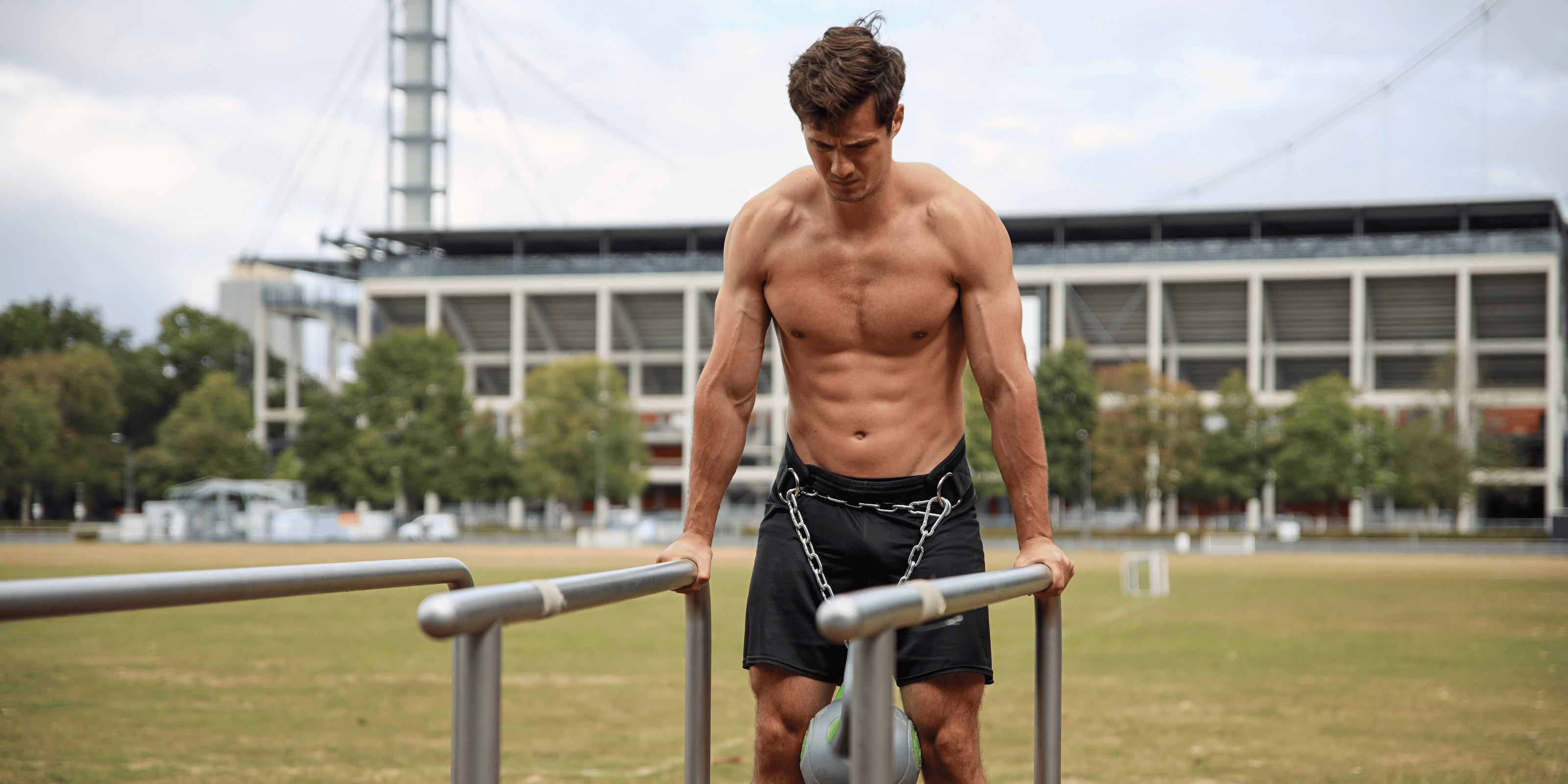
Weighted calisthenics describes training with additional weight to increase strength and muscle mass. Exercises such as pull-ups, dips or squats are performed with Dip belts, Weight vest or Dumbbell discs intensified. The goal can be both muscle building and improving relative strength.
Streetlifting is a competitive discipline developed from Weighted Calisthenics. Strict rules apply here, and the goal is to establish the Maximum additional weight to be handled.
In short: Weighted calisthenics is the general training method, while streetlifting is the Competition discipline This is the method.
The Four Basic Exercises in Streetlifting
In the streetlift there is Four established exercises, which are completed in competitions. Each has clear technical requirements and specific rules for a valid execution.
Weighted muscle-up
Streetlifting competition rules:
- Starting position: Fully extended arms (180° elbow). Grip: Semi-false allowed (bar), false grip allowed (ring), no complete false grip allowed at the bar.
- Kipping/Kicking: Minimal movement allowed, strong swinging forbidden. Completely extended arms over bar/rings necessary.
- Chicken Wing: One-sided overcoming of the bar/rings with the elbows forbidden one after the other.
Necessary equipment

Weighted calisthenics version:
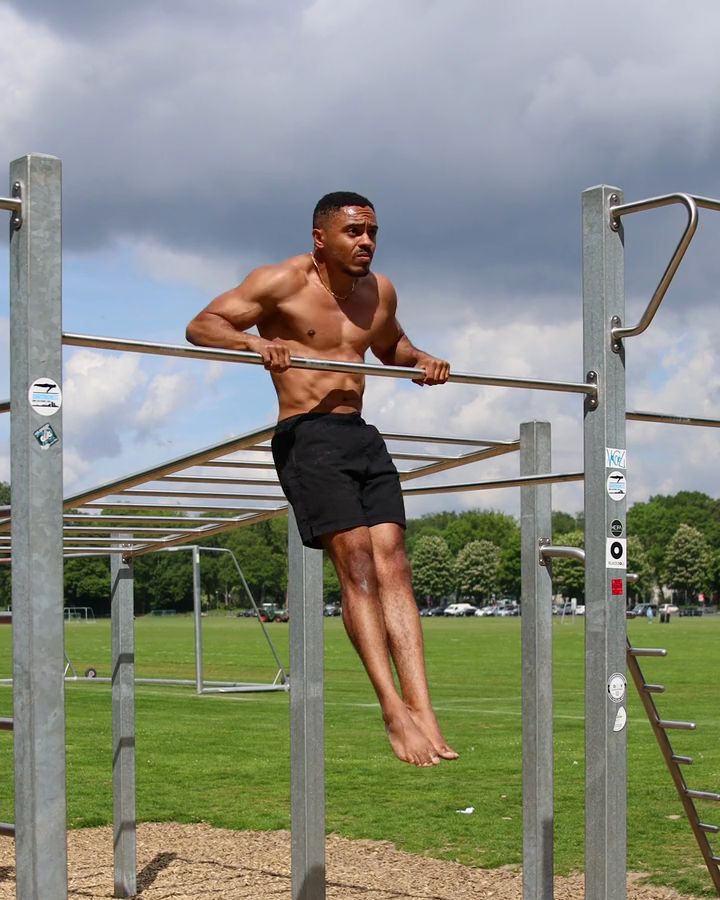
- Start in hang position
- Grab the bar slightly wider than shoulder width in semi-false grip or instep grip
- Let your body swing slightly forward while tensing your core
- At the pendulum's front turn point, bend your arms and pull your chest explosively towards the bar
- Pull yourself up as high as possible and keep your chest close to the bar
- At the highest point, rotate your wrists so that you are leaning with your hands on the bar
- Lean on the bar with your chest and bring your elbows up
- Press yourself up into the support and stretch your arms completely
- Slowly lower yourself back into the hang in reverse order and in a controlled manner
- If you need to complete multiple repetitions, you can shuttle back and forth once between repetitions or pull yourself up again immediately after a repetition
Weighted pull-ups
Streetlifting competition rules:
- Starting position: arms fully extended (180° elbow), freely suspended.
- Handle variants: Chin-Up (Supinated) or Pull-Up (Pronated), change allowed at any time.
- Height: Chin must be visible above the rod (vertical).
- Kipping/Kicking: Minimal movement allowed, swing fetching strictly prohibited.
- Closure: Back to the starting position and waiting for the closing signal required.
Necessary equipment
Weighted calisthenics version:
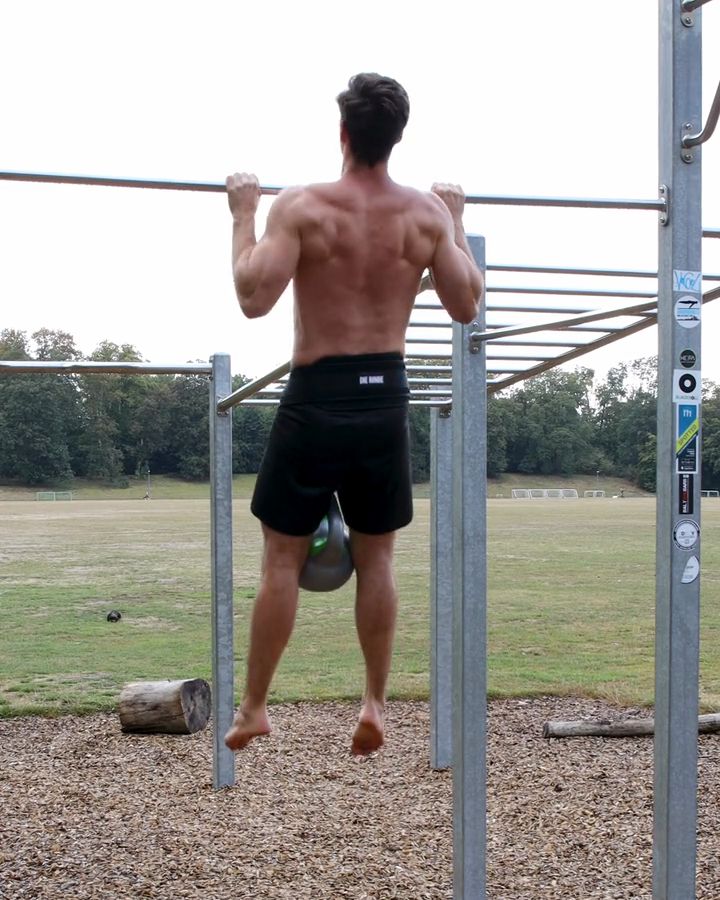
- Start in a hang position with extended arms
- Grab the bar in the instep grip so that the fingers point away from you
- Your grip width is at least shoulder width
- Pull your shoulder blades back down at the start
- Bend your arms and pull the bar towards your chest
- Try to pull yourself up as high as possible, at least with your head above the bar
- Lower yourself slowly and controlled back into the hang position
- Work in the largest possible range of motion
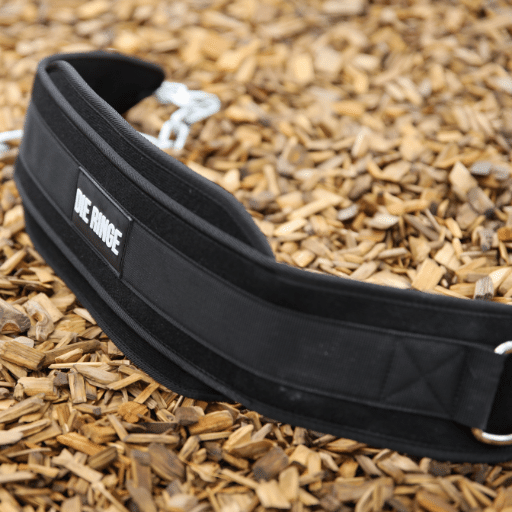
- As an alternative to the weight belt, you can also use a weight vest or clamp a dumbbell between your thighs
Weighted dips
Streetlifting competition rules:
- Starting position: Stretched arms (180° elbow), minimal movement allowed in the knees.
- Depth: upper edge rear shoulder lower than elbow, hip at least at the height of the dip spar.
- Kipping/Kicking: Minimal movement allowed, strong swinging forbidden.
- Control: No loss of control or touch of the box before the final signal.
- Completion: Return to the starting position and waiting for the final signal required.
Necessary equipment

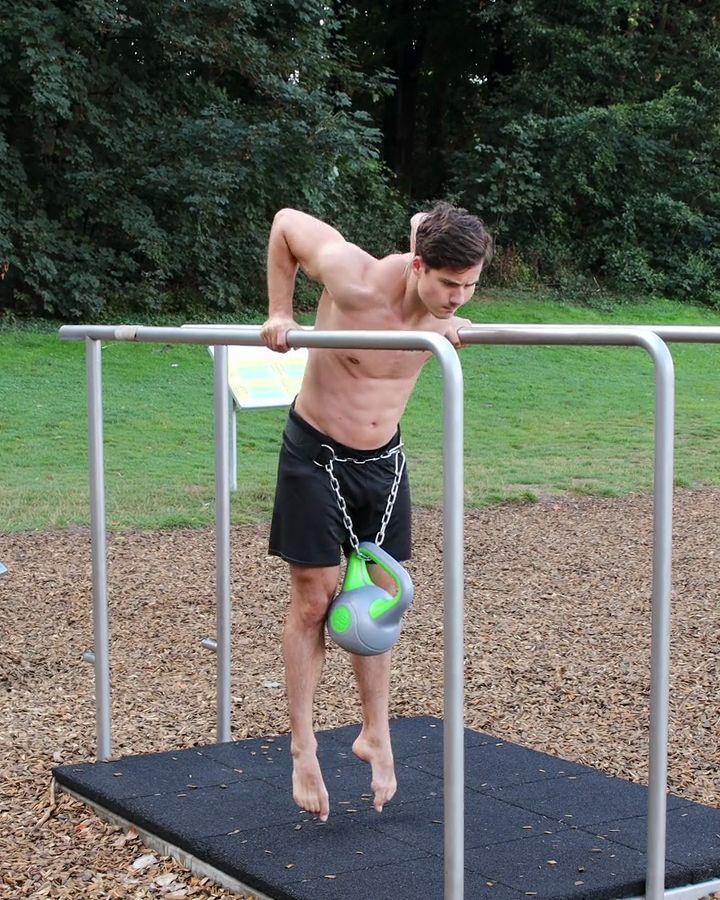
Weighted calisthenics version:
- Start in support
- Press your shoulders down
- Bend your elbows at least 90 degrees and lower yourself towards the floor
- Keep permanent tension in torso and buttocks
- Stretch your arms and press back into support
- Work in the largest possible range of motion
- As an alternative to the weight belt, you can also use a weight vest or clamp a dumbbell between your thighs
Weighted squats
Streetlifting competition rules:
- Starting position: knee and hip completely stretched, movement start only after signal ("squat!").
- Depth: hip joint deeper than upper knee edge ("below parallel"). Closing position: the knee and hip must be fully stretched again.
- Foot movement: Minimum lateral or rolling movement allowed, but no change of position.
- Dropping the dumbbell: Active dropping or dropping of the dumbbell leads to immediate disqualification and suspension.
Necessary equipment
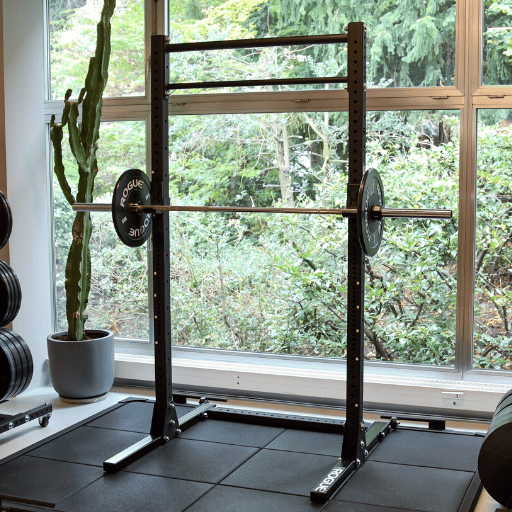
Weighted calisthenics version:
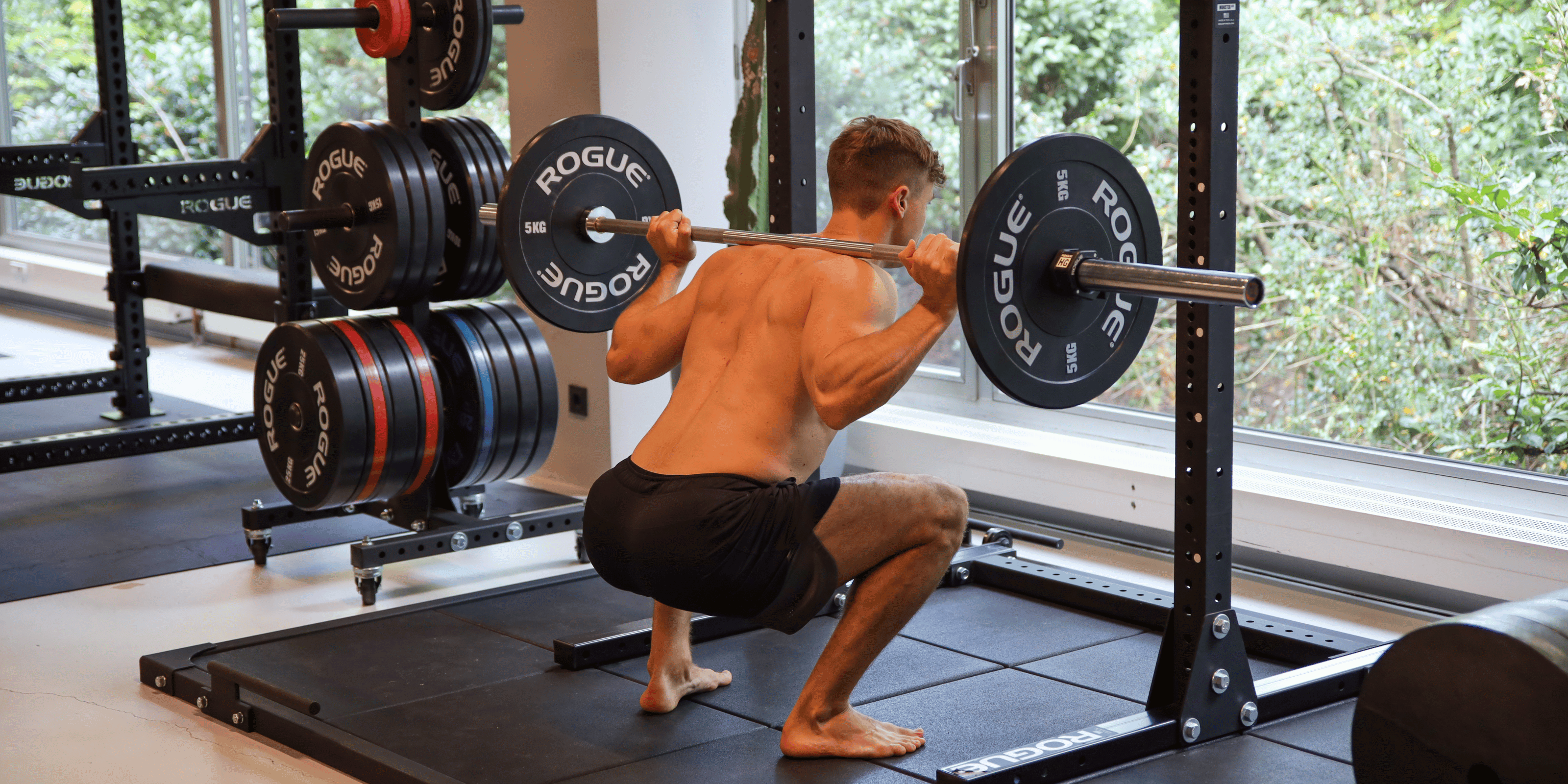
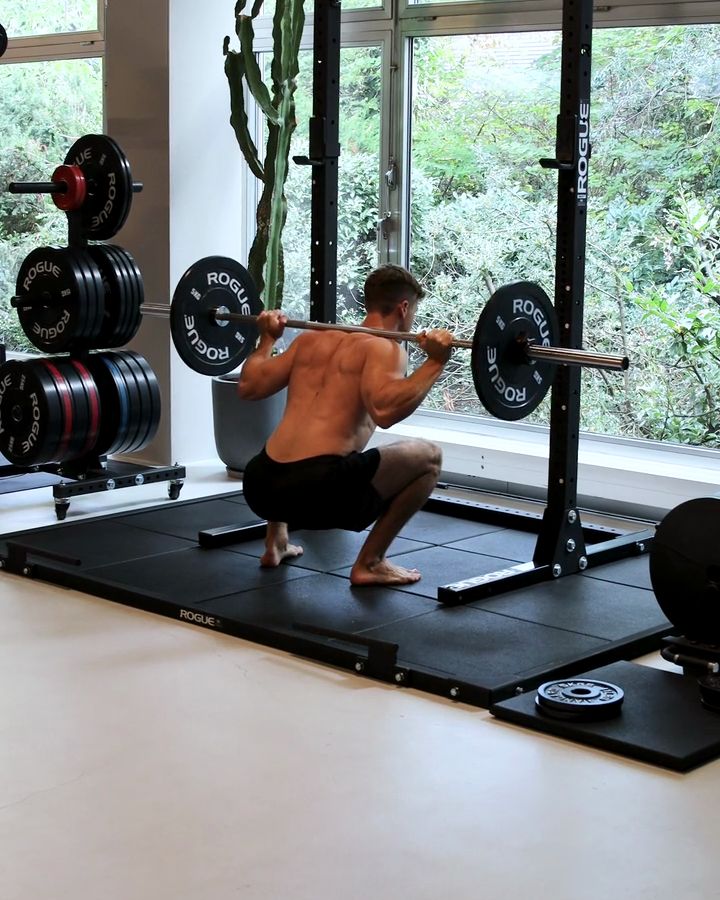
- Choose a grip width that is comfortable for you, at least shoulder width.
- Stabilize your shoulders by trying to bend the barbell upwards
- Place the barbell on the delta muscle (neck muscles)
- Lift the barbell from the bar with a stable torso and take a small step backwards
- Stand hip to shoulder width apart
- Screw your feet into the floor so that your knees rotate outward
- Toes point forward and are turned slightly outward
- Elbows point down and shoulder blades are pulled back ( retraction)
- Remain as upright in the torso as possible during the squat
- Bend the knees and lower your hips below the knees
- The thigh should be at least parallel to the floor
- Then stretch your legs with tense buttocks
- Keep tension in torso, shoulder girdle and buttocks throughout
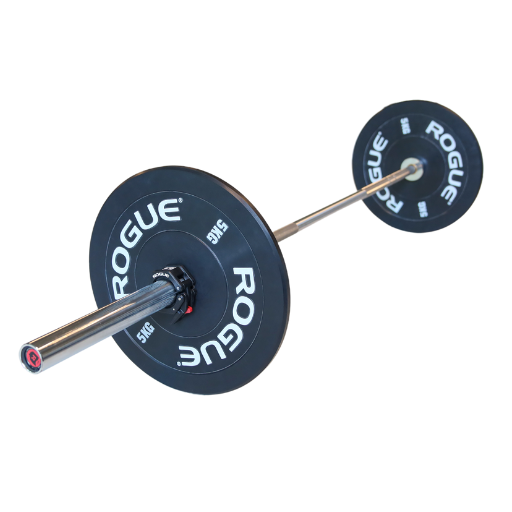
- The training weight for this exercise is the sum of the barbell's own weight and the additional weight plates
Benefits of Weighted Calisthenics
Why is it worth exercising with extra weight? Streetlifting and Weighted Calisthenics There are numerous advantages that are attractive for both strength athletes and calisthenics athletes.
Maximum increase in force
Streetlifting is a Maximum strength, which is about moving the highest possible additional weight in the four disciplines. Through regular training with additional weight you can significantly increase your absolute strength.
Effective Progressive Overload
As in powerlifting or weightlifting, training is based on the principle of Progressive overload. This means gradually increasing your workout weight to make continuous progress.
Optimal competition preparation
Streetlifting is a Structured competitive sport, where clear rules apply. If you want to participate in a competition, targeted training can meet exactly the requirements that are necessary for a valid repetition.
Improvement of body control and explosiveness
Especially the Muscle-Up with additional weight requires a combination of explosiveness and clean technology. By training with additional weight, you not only develop strength, but also a better Body control.
Tip: If you’re new to Weighted Calisthenics, start with moderate extra weight and slowly increase. Technical cleanliness is essential to be successful in streetlifting.
Training Building: How to Start with Streetlifting
How often should you train streetlifting? Which methods are most effective?
Training Frequency: How Often Should You Exercise?
- Streetlifting training should be 3–4 times a week take place.
- Focus on the four basic exercises as they form the basis of the sport.
- Break days for regeneration are essential, as maximum strength training strongly strains the nervous system.
Progressive Overload: The Right Stress Increase
- Training weight should be increased gradually to avoid injury.
- Repetition ranges depend on the training goal:
- 1–5 repetitions for maximum force
- 6–12 repetitions for hypertrophy and endurance
Training methods: Maximum strength training vs. Muscle building
- Streetlifting is a maximum strength sport, so the focus should be on Heavy weights and low repetitions lie.
- Supportive exercises, such as: Face pulls For shoulder stabilitycan help improve the basic exercises.
Tip: Training planning is similar to that in powerlifting – many concepts from this area can be transferred to streetlifting.
The right equipment for streetlifting
Streetlifting requires specific equipment to train safely and effectively.
Dip Belt vs. Weight Vest: Which Is Better?
- Dip beltsIdeal for heavy training, as the weight is directly attached to the hip.
- Weight vestBetter for even weight distribution, but less suitable for maximum strength.
Which shoes and gloves make sense?
- Flat shoes or barefoot training for better stability in squats.
- Handle gloves or chalkto prevent slipping during pull-ups and dips.
Additional tools for effective training
- Resistance bands to assist in warming up.
- Handle aids for heavy pull-up or muscle-up training.
Competitions & Community: The streetlifting scene
Streetlifting is not only a training, but also a Competition sportwho finds more and more followers. In Germany, there are now several organized competitions in which athletes compete against each other.
Competition format and rules
A streetlift competition is similar to a powerlift or weightlift competition. The athletes have Three attempts per exercise, around that Maximum additional weight in one of the four disciplines. The best valid attempts from each exercise are counted together to Total (total) to be determined.
The order of disciplines is usually:
1️⃣ Muscle up
2️⃣ Pull-up (pull-up with additional weight)
3️⃣ Dip (dips with additional weight)
4️⃣ Squat (squat with additional weight)
Important competition rules
- Weight classes: Athletes compete in different weight classes, but their own body weight is not counted.
- Valid repetitions: Each exercise has strict movement specifications – for example, when pulling up, the arms must be completely stretched before the repetition begins, and the chin must cross the rod.
- Disqualification: At least one valid repetition per exercise is required in order not to be excluded from the competition.
- Strict movement execution: Swing movements, “chicken wing” muscle ups or uncontrolled movements lead to invalid attempts.
Tip: Anyone who wants to prepare for a streetlift competition should Official rules Study carefully and align the training accordingly.
Well-known events & associations in Germany
🇩🇪 DCS (German Calisthenics & Streetlifting Association)
- Organised National championships in Germany.
- Regional competitions, for example. North German and South German Championship.
- Organized both national and International competitions.
- The host of the European Championship and World Championship.
- Participation in international competitions requires qualification.