Turning Rings vs. Bars: Extension Support and Muscle Activation
You want to know how the stretch support on gym rings and bars affects the activation of your muscles? In this blog article, which is based on Paul’s bachelor thesis and contains his empirical research on the topic, you will learn everything you need to know about the basic position in gymnastics and how it affects your athletic abilities.
If you find the following text too extensive or prefer visual explanations, we also have a video for you. Paul explains to you the basics of the stretch support in gymnastics and the differences between rings and bars and how he conducted his study.

You want to know how the stretch support on gym rings and bars affects the activation of your muscles? In this blog article, which is based on Paul’s bachelor thesis and contains his empirical research on the topic, you will learn everything you need to know about the basic position in gymnastics and how it affects your athletic abilities.
Extension support in gymnastics: a study on the activation of muscles on rings and bars
Strengthening Support: The Basic Position in Turning
The stretch support is an important basic position in gymnastics, which can be performed on both gym rings and bars. It forms the basis for numerous other exercises and is crucial for the development of a solid muscular safeguard that minimizes the risk of injury.
Muscle Activation: Turning Rings vs. Bars
With stretch support on turn rings and ingots, support strength, stability in the shoulder belt and whole body tension improve. This exercise forms the basis for other elements such as handstand, angle support and rim upswing and promotes the acquisition of a basic muscular level.
Research status: Biomechanical investigations in equipment gymnastics
In previous research, the focus is on demanding elements and isometric exercises such as the Kreuzhang or the Schwalbe. Basic elements such as handstand and stretch support are of great importance for the understanding of techniques and safety in training.
Aim of the study: Comparison of stretch support on gym rings and bars
Paul’s study examines muscle activity in stretch support on gym rings and ingots in order to meet the requirements of Prassas et al. (2006) and to enable a comparison of muscle activity of stretch support on the parallel ingot of Appell & Stang-Voss (2008) and of stretch support on the rings. Special attention is paid to the interaction between the device and the athlete, both to deepen the understanding of the elements and techniques and to increase safety in training.
Study participants and design
In this study, 14 male gymnasts participated who had experience in both parallel bars and rings. The investigation took place in Hall 21 of DSHS Cologne, where both required devices were available. Participants signed a consent form and provided information on age, training age, training load and any injuries.
Heating and measurement preparation
Before the measurements began, the athletes warmed up standardized to take into account the specific load patterns. Electromyography (EMG) measurements were then carried out to normalise later data.
EMG measurement during support exercises
Participants performed stretch support exercises on parallel bars and rings while their muscle activity was measured using EMG. The electrodes were attached to various muscles of the dominant side of the athletes to detect muscle activity during exercises.
Materials and preparation
For the measurement, wireless electrodes were used, which were applied to the skin with adhesive strips. In order to reduce motion artifacts and to support adhesion, a fixing tape was additionally glued over the electrodes.
Data collection and statistical analysis: study of muscle activity in various support conditions
Data was collected by transferring electrode data to the working computer of the test conductor. The EMG data was normalised and analysed and prepared using special software. The statistical analysis included the t-test for connected samples, the Wilcoxon test and pre-test tests for normal distribution. Examination of muscle activity enabled testing of the hypothesis that activity differs significantly in different supporting conditions.
Table of muscle activity differences between stretch support on gym rings and parallel bars
| Muscle | Device with higher muscle activity | Significance | Effect size (d) |
| M. pectoralis major | Rings | p < .001 | 1.59 |
| Serratus anterior | Rings | p = .00 | 1.32 |
| M. deltoideus p. clav. | Rings (not significant) | p > .11 | - |
| M. deltoideus p. spin. | Rings (not significant) | p > .36 | - |
| infraspinatus | Rings (not significant) | p > .11 | - |
| M. Latissimus dorsi | Rings | p = .00 | 1.36 |
| M. trapezius transv. | Parallel bars | p > .002 | 1.45 |
| M. trapezius ascend. | Parallel bars | p > .001 | 1.54 |
The table shows the results of the study in an easily understandable and clear form. It shows the muscles, the device with the higher muscle activity, the significance and the effect size. Significant results are highlighted while non-significant differences are marked accordingly.
Muscle activity study in stretch support on rings and parallel bars: results and findings
The study examined muscular activity in the stretch support on the parallel bar and rings. Five of the eight muscles studied showed significant differences in their muscle activity. Results showed that the stretch support on the rings had higher muscle activity in the muscles M. pectoralis major, M. serratus anterior and M. latissimus dorsi, while the stretch support on the parallel bar had higher muscle activity in the muscles M. trapezius transversa and M. trapezius ascendens. The study suggests that pendulum suspension of the rings could lead to differences in muscle activity and that muscle activity of the anterior M. serratus plays an important role in stabilizing the shoulder blades in the extension support on the rings. An earlier study examining handstand on parallel bars, rings and floor showed similar results, suggesting that a shoulder strategy is used for stretch support on the rings and a wrist strategy for stretch support on the parallel bar for balancing.
Limitations and Criticisms of the Study
The measurement of muscle activity in the support on the rings
In the EMG measurement, when measuring muscle activity in the support on the rings, two values occurred that were higher than the previous MVIC measurements, resulting in a percentage muscle activity of more than 100%. These two measurements were a measurement of the M. pectoralis major with 111% and a measurement of the M. latissimus dorsi with 106% in the extension support on the rings. It is presumed that the values which are too low in the MVIC measurements are due to a poor execution, i.e. poor control of the muscle group to be activated is due to the MVIC tests. This problem did not occur in the tests to find the appropriate MVIC test. This reinforces the assumption that poor control and execution in the MVIC tests could be the cause. Furthermore, the instability of the rings may have contributed to the fact that during short compensation movements enormous forces were caused in M. pectoralis major and M. latissimus dorsi.
Not measured muscle activity of M. rhomboideus and M. pectoralis minor
The M. rhomboideus and the M. pectoralis minor play a crucial role in the stabilization of the shoulder blades. However, due to the technology, it was not possible to safely detect the muscle activity of these two muscles with surface electrodes. Fine-wire electrodes, which were not available to the study director, must be used to reliably detect the activity of these muscles. Therefore, it was necessary to refrain from measuring these muscle groups.
Limited number of surface electrodes
In addition, only eight surface electrodes were available to the study director. In order to ensure a detailed examination of the upper body muscles, these eight electrodes were fastened there. It had to be disregarded from a consideration and measurement of the muscles of the upper and lower arms. A second measurement for upper and lower arms was not performed in order not to double the duration of the intervention and not to make the process more unpleasant for the subjects.
The importance of adductors in the stretch support on the rings: recommendations for fitness and gymnastics
The study shows that in the execution of the stretch support on the rings, the adductors of the arm play a more important role than the rotator cuff. For recreational athletes in the field of fitness and calisthenics, it is recommended to strengthen the large muscle groups of the upper body, in particular the M. latissimus dorsi and the M. pectoralis major. In gymnastics, the results of the study can be applied to angle support, as it often shows general error patterns. A further possibility, in addition to the increased practice of the stretch support, could be a strengthening of the two strong adductors M. pectoralis major and M. latissimus dorsi. An execution of the exercises on the rings would be optimal in order to make the gym training, which is already very busy, effective and time-efficient. In subsequent research projects, differences between muscle activity in upper and lower arms in the extension support on the parallel bar and on the rings could be investigated as well as investigations of other force elements between rings and parallel bars.
Overall, the study shows that stretch support on the rings is an effective way to strengthen upper body support muscles. The results of the study can be important not only for gymnasts, but also for recreational athletes in the field of fitness and calisthenics. It is particularly important to train the large muscle groups of the upper body, such as the M. latissimus dorsi and the M. pectoralis major. Even with errors in angle support and handstand on the rings, targeted exercises and a strengthening of the right muscles can provide a remedy. Through targeted and effective training on the rings, athletes can improve their support muscles and increase their performance.
In the following video you will find more content about the comparison between rings and bars:
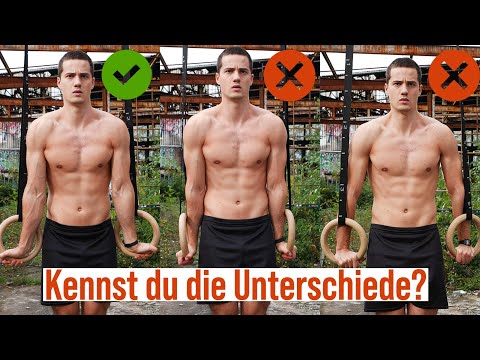
We hope that this short summary of Paul’s bachelor thesis could offer you added value and made you curious about the topic. Please note that the content of this blog article has been highly compressed to ensure an understandable and concise presentation. If you are interested in further information and detailed results of the study, we recommend reading the complete work.
Bibliography of the bachelor thesis
| Author(s) | Year | Title |
| Appeal and Stang-Voss | 2008 | Functional anatomy. Basics of sporting performance and movement |
| Bennett | o. J. | Gymnastic Rings Support Hold (Everything You Need to Know) |
| Bernasconi et al. | 2004 | Surface electromyography of nine shoulder muscles in two iron cross conditions in gymnastics |
| Bessi | 2007 | Materials for trainer training in equipment gymnastics – 2nd license level |
| Bessi | 2009 | Materials for trainer training in equipment gymnastics – 1st license level |
| Boettcher et al. | 2008 | Standard maximum isometric voluntary contraction tests for normalizing shoulder muscle EMG |
| Burden | 2010 | How should we normalize electromyograms obtained from healthy participants? |
| Campos et al. | 2011 | The swallow element and muscular activations |
| Carrara et al. | 2016 | The cross on rings performed by an Olympic champion |
| Clarys | 2000 | Electromyography in sports and occupational settings: an update of its limits and possibilities |
| Dal Maso et al. | 2016 | Optimal Combinations of Isometric Normalization Tests for the Production of Maximum Voluntary Activation of the Shoulder Muscles |
| Gautier et al. | 2009 | Dynamics of expertise level: Coordination in handstand |
| Hedbávný et al. | 2013 | Balancing handstand on the floor |
| Kochanowicz et al. | 2019 | Changes in the Muscle Activity of Gymnasts During a Handstand on Various Apparatus |
| Konrad | 2011 | EMG FIBEL. A practical introduction to kinesiological electromyography |
| Mitchell et al. | 2002 | Teaching fundamental gymnastics skills |
| Myers | 2014 | Anatomy Trains. Myofascial pathways for manual and movement therapists |
| Prassas | 1999 | Biomechanical research in gymnastics: what is done, what is needed |
| Prassas et al. | 2006 | Biomechanical research in artistic gymnastics: a review |
| Robertson et al. | 2014 | Research methods in biomechanics |
| Schulz and Grimes | 2007 | Series Epidemiologi 6th Journal of Medical Training and Quality in Health Care |
| Schwartz et al. | 2017 | Normalizing shoulder EMG: An optimal set of maximum isometric voluntary contraction tests considering reproducibility |
| Yeadon et al. | 2012 | The biomechanical design of a gymnastics training aid for a handstand on the rings |
| Yeadon and Trewartha | 2003 | Control strategy for a hand balance |