Effective leg training with the DIE RINGE App: holistic upper and lower body training
Turning rings: Holistic training and not only for the upper body
The strengths of training on the gym rings are mainly in the area of upper body training, and this is also the focus of our DIE RINGE App. However, this does not mean that it is not possible to effectively train the lower body, especially the legs, with the gym rings and our app.
In order to avoid dysbalances and weak points, it is essential not to neglect the lower body. With the innovative leg training programs of DIE RINGE we offer two different training variants that make it possible to train legs sustainably and progressively with your own body weight or with weights.
Leg Training 1: Bodyweight Training for Strong Legs
In this effective training, minimal equipment is required – only gym rings, posts and an edge or elevation. The focus here is on explosive jumps, where first the Shrimp Squat and later the challenging Pistol Squat are learned.
Leg Training 2: Weight Training for Strong Legs
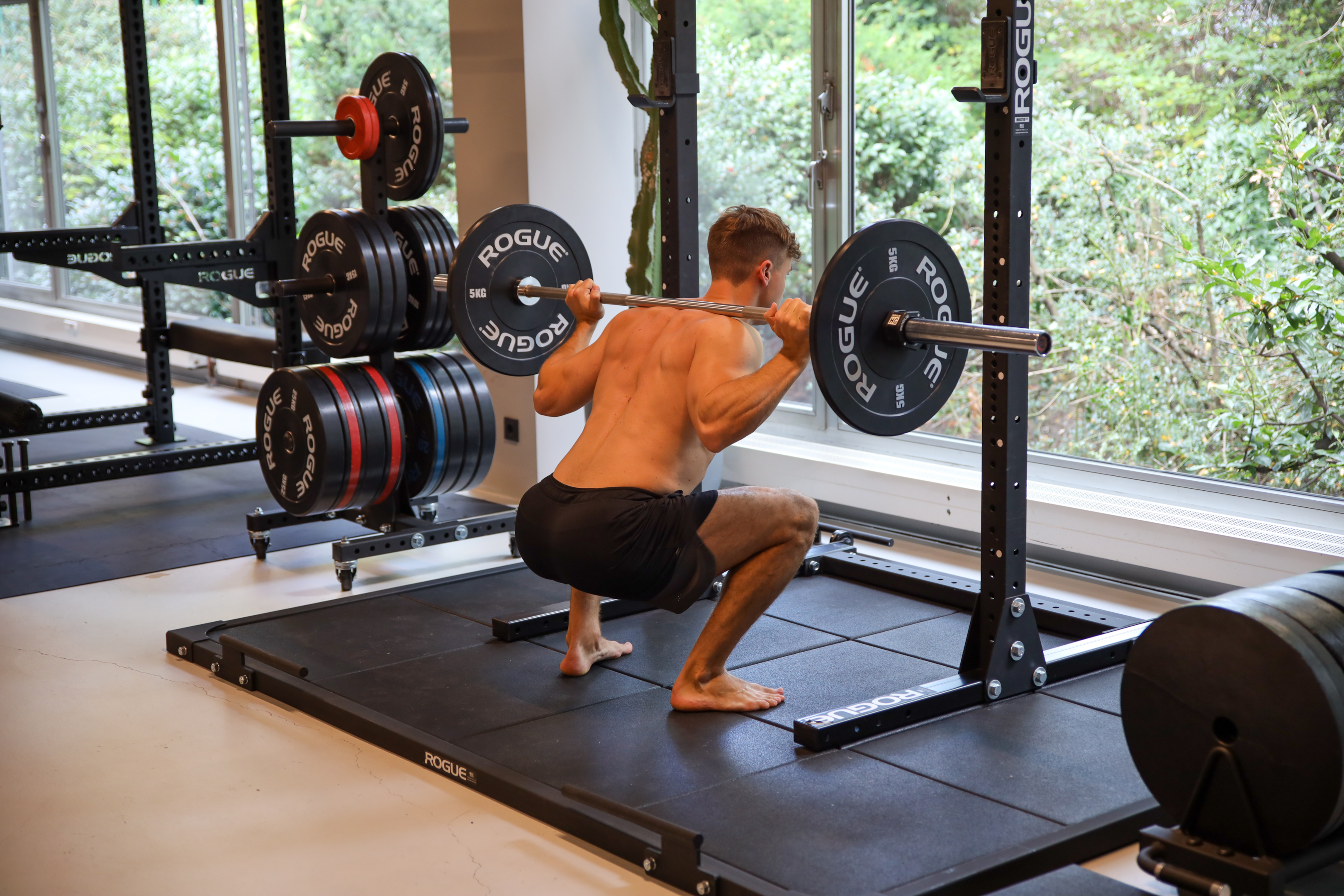
For this strength-oriented training you need more equipment, such as the common weights that are available in every gym. You will mainly work with dumbbells and barbells in this training style to become particularly powerful in exercises such as Bulgarian split squats, squats and deadlifts.
Individual training planning with the DIE RINGE Coach
The DIE RINGE Coach in the app plans your optimal training week and adapts individually to your needs. It takes recovery times into account and ensures that upper body and lower body training are harmoniously integrated into your weekly training plan.
Exercise on one leg: Unilateral exercises for balance and torso stability
One of the main components of DIE RINGE App leg training is unilateral exercises in which training is done on one leg. This has numerous advantages, such as higher training intensity and strengthening of the core muscles. It also improves balance and stability. The aim of this training series is to master several clean skater squats, which are learned in several progression levels.
Explosiveness and Jumping Power: Plyometric Exercises for Powerful Legs
Other exercises focus on explosive and plyometric exercises, such as cracked squats. This type of training offers many benefits, such as strengthening muscles and tendons, improving mobility and stimulating metabolism. By gradually exchanging the exercises, the intensity is increased.
Focus on the back of the leg: training for leg flexors and buttocks
Finally, both types of leg training focus on the back of the leg, especially leg flexors and buttocks muscles. These muscle parts are often neglected, although they are essential for many everyday movements. To avoid dysbalances, these muscles are specifically trained and strengthened, for example with exercises such as the board or leg curls on the gym rings.
Phase training: Individually adapted training structure
The training program is based on the principle of phase training, which you may already know from ring training, and therefore asks for the number of completed repetitions per set in each unit. This information serves as a basis for the adjustment of the training plan. When successfully coping with all repetitions, a progression occurs by adjusting either the training volume or the exercise intensity.
The more frequently the leg training is done, the better and more individually the training goals are adapted to you. In addition, the exercises can be adjusted manually, for example to increase or reduce the difficulty level at the beginning of training or after a longer break.
Different requirements for change of progression
The different exercises have different requirements until a progression is exchanged. While some exercises only need to reach the maximum number of repetitions once, others are more technically demanding and require more training sessions to improve coordination and technique.
Classification and individual adjustment of leg training with the DIE RINGE coach
Before the leg training begins, the DIE RINGE coach performs an assessment to determine your current training status and select the appropriate exercises for you. Regardless of your level of experience or whether you are just starting training on the gymnastics rings, the leg training feature is suitable and recommended for all ring athletes.
No requirements required: leg training for all ring athletes
The leg training feature does not require any special requirements compared to other training goals. Regardless of your current level or experience at the gymnastics rings, this leg training can and should be regularly performed by all ring athletes.
By grading and customizing leg training, the DIE RINGE Coach ensures that training is effective and challenging for both beginners and advanced athletes. In this way, everyone can benefit from the advantages of holistic and targeted leg training.
Individual training rhythm and optimal break time by the DIE RINGE coach
The DIE RINGE Coach creates the perfect rhythm for you based on your registered training days and determines the optimal break time between training sessions. So you don’t have to worry about how often you need to do leg training a week. Training is recommended at least once a week so as not to neglect your lower body. Depending on your training plan and progress level, you can do leg training up to three times a week, with a 48-hour break between two sessions at best to give your body enough time to regenerate.
The DIE RINGE Coach even tells you what the order is when you have several training sessions in a day – for example, if you want to train other skills. The leg training sessions last between 20 and 90 minutes, depending on your progress level.
Combine your leg training with other skills
The DIE RINGE Coach makes it possible to combine leg training with other skills, such as muscle-up. Thus, upper body training is not replaced by the DIE RINGE App, but supplemented and enriched. The coach adapts the training to your individual needs and creates the optimal training plan – even if you want to complete several training sessions in one day.