Split Training for Beginners: What Makes Sense?
Overlooking training plan confusion: Your path to fitness success
Excessive in training plans? Split training, 5x5, GK training – the offer seems endless! Don’t get confused by fitness experts, magazines or YouTubers. We will show you how to unravel the training chaos and make the right decisions to achieve your goals effectively. No miracle pills or fancy exercises – just deep knowledge to create your perfect workout plan. Now discover how easy it can be!
Scientific muscle building: Facts for effective training
The topic of muscle building is extensively studied in sports science. Muscle building or muscle hypertrophy is a thickening or thickening. Enlargement of existing muscle fibers. Training parameters such as training frequency, training intensity and training volume are considered in countless studies to find out how an optimal training plan should be put together. We want to use these current findings here to provide you with a basic understanding of muscle building.
Split Training for Beginners: Meaningful or Not?
In countless bodybuilding and fitness magazines, it is often claimed that a split training plan is the best training principle for muscle building. Before we explain why this is not true for beginners, let’s first look at what a split training plan actually is:
In a split training plan, the training is designed so that only certain muscle groups are trained per training day. Thus, we split (divide) the training. An exemplary split training plan could look like this:

Such a plan seems reasonable at first glance, but is not suitable for everyone. Split training is usually only the right choice for advanced bodybuilders. For beginners, on the other hand, such a plan is often counterproductive, since the muscles are too intensively loaded and only slowly training successes become visible.
Beginners & Split Training: Understanding Training Theory & Super Compensation
Why is this plan not for beginners? Here is a small digression into training teaching needed to understand the basics of strength training:
For a muscle to grow, we need to irritate it. This means that we have to move the muscle so intensively that it is not up to the load. We do this in the form of strength training. If the strain of the training was large enough and we have exceeded the necessary stimulus threshold, there are many small injuries in the muscle. We perceive these microscopic cracks in the muscles as sore muscles. Our body repairs these traumas and additionally strengthens the muscle so that it is prepared for such stresses in the future. As a result, the muscle is stronger after the regeneration phase than it was before training. This phenomenon is called “supercompensation” in sports science.
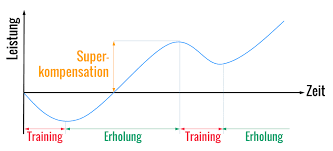
In theory, it all looks simple. In the implementation, however, the whole thing becomes more complex, since each person has an individual stimulus threshold and therefore requires a suitable training load for optimal stimulus.
Split Training for Beginners: Intensity, Muscle Adaptation & Training Balance
Researchers Schoenfeld & Brad (2012) observed in many studies the adjustment of muscle after strength training. They were able to determine that a muscle can also be damaged too much and it comes to performance losses. For us, this means: More is not the same as better! The following graphic shows how an unsustainable, too strong training stimulus drives us into ruin in the long term.
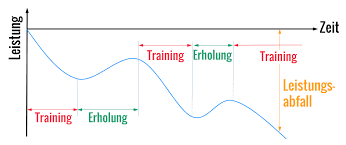
As we can see in the picture, we do not become stronger in this training rhythm, but weaker. However, this theory still does not confirm that split training is unsuitable for beginners.
Split Training: Intensity, Muscle Soreness & Differences Between Beginners and Advanced
In split training, we train a certain muscle group very intensively in a training session. For this purpose, many exercises are often used that irritate the same muscle several times. The load on the trained muscles is enormous and in beginners often ends in sore muscles that lasts for days or even weeks. It is precisely this muscle soreness that is counterproductive to our progress. It shows us that we have exceeded our stimulus threshold too far and severely restricts us in our following training sessions.
Advanced strength athletes, on the other hand, can apply this training principle because they can tolerate this enormous load on a muscle group. Years of strength training have increased, among other things, the stimulus threshold for renewed muscle growth and trained athletes have a better regenerative ability and can expose themselves to new stimuli faster. For beginners, however, this principle is still the wrong approach.
Full body training for beginners: The optimal start to strength training
The right way to start with strength training or for a comeback after a long training break could be full-body training (GK training). This methodology, as the name suggests, includes 2-3 training sessions in which the whole body is trained. For beginners, this principle is completely sufficient to ensure successful muscle growth. As a beginner, our stimulus threshold, which we need to exceed in training for muscle growth, is very low and we only need a few stimuli to stimulate our muscle growth.
Milder stimuli, but a higher frequency!
Researchers Schoenfeld, B. J., Ogborn, D., & Krieger, J. W. (2016) investigated in a systematic review how often a muscle should be trained a week. They came to the conclusion that 2 to 3 times a week is the optimal frequency for strength training. In this training pattern it is possible to maximize muscle growth. Especially as a beginner, you should therefore rather set milder stimuli but train more often in the week in order to optimally exploit the conditions of the low stimulus threshold.
Despite comprehensive units, you should train purposefully and efficiently
So that our GK training does not end in a 4-hour training, time-saving basic exercises are usually used for each body region, in which entire muscle chains are combined trained. In order to keep the fun of strength training, we give you the tip to follow a time-efficient and progressively increasing training plan.
No plan = less success
This plan prevents you from never getting stumped and bored into the gym without really knowing how best to exercise today. Take the time and think before your upcoming training weeks how your training should go! Only in this way will you be able to strengthen your staying power and get a little closer to your goals. To give you a little idea of what your training week might look like, we show you two example rhythms for a training week.


Whole-body training for beginners: duration, success measurement and training adjustment
How long should you pursue full body training as a beginner? This question cannot be answered in general, as each athlete adapts individually and factors such as recreation, nutrition and everyday activities play a role.
Measure your training success against external changes and record your training sessions. When it comes to stagnation and you can rule out other reasons, consider adjusting your training method. Experience shows that this takes several months or even years.
Factors such as motivation, discipline, technique and progressive increase are crucial for beginners. Deepen your knowledge about muscle hypertrophy and its impact on your training in our Article 1.
Are you looking for a training plan that takes all these factors into account? Test our "DIE RINGE App", which introduces beginners to strength training in a structured way. The app offers a progressively increasing training program for muscle building with minimal tools. You can test the app directly for free! 🙂
Get started with the DIE RINGE App
In the DIE RINGE App, an algorithm will plan your perfect training week with which you will achieve your goals.