Learning to Row Ring: Step by Step Guide!
Hello and welcome! Are you looking for an effective way to strengthen your body holistically while shaping an athletic figure? Then you are exactly right here! In this article, you’ll learn all about rowing on the rings, one of the most effective muscle building exercises. Not only is this exercise extremely popular, but it also appeals to a variety of muscles that will help you maintain an upright posture and an impressive V shape.
Learn why rowing on the rings is so effective and how it helps you exercise comprehensively from the back muscles to the arm and core muscles. Whether you are now ane new entrantsin are or already advanced, we have the right tips and tricks for you ready. Learn how to perform the exercise correctly, avoid common mistakes, and how to make the most of your training for maximum results.
Dive into the world of wrestling training with us and discover how rowing on the wrestles both strengthens your body and increases your self-confidence. Ready? Then grab your rings and let’s get started!

Benefits of Ring Rowing: How Effective Is Exercise Really?
Rowing on the rings is more than just an impressive fitness exercise – it is a holistic strength training with many benefits. This exercise is a real power package for your entire body and is great for people of all genders. Strength training, especially rowing on the rings, helps develop a strong, well-formed and healthy figure without women having to worry about getting an overly muscular back. It is important to question outdated stereotypes, because strength training strengthens the body, improves posture and contributes to overall health. So don’t let outdated ideas limit you – rowing on the rings can be a valuable addition to any training program.
When rowing on the rings, numerous muscle groups are simultaneously stressed, which not only promotes balanced muscle building, but also improves intermuscular coordination. The main muscles involved include the large back muscles (latissimus dorsi), the shoulder muscles (delta muscles), the biceps and the torso muscles (core), which leads to improved posture and a strong body center.
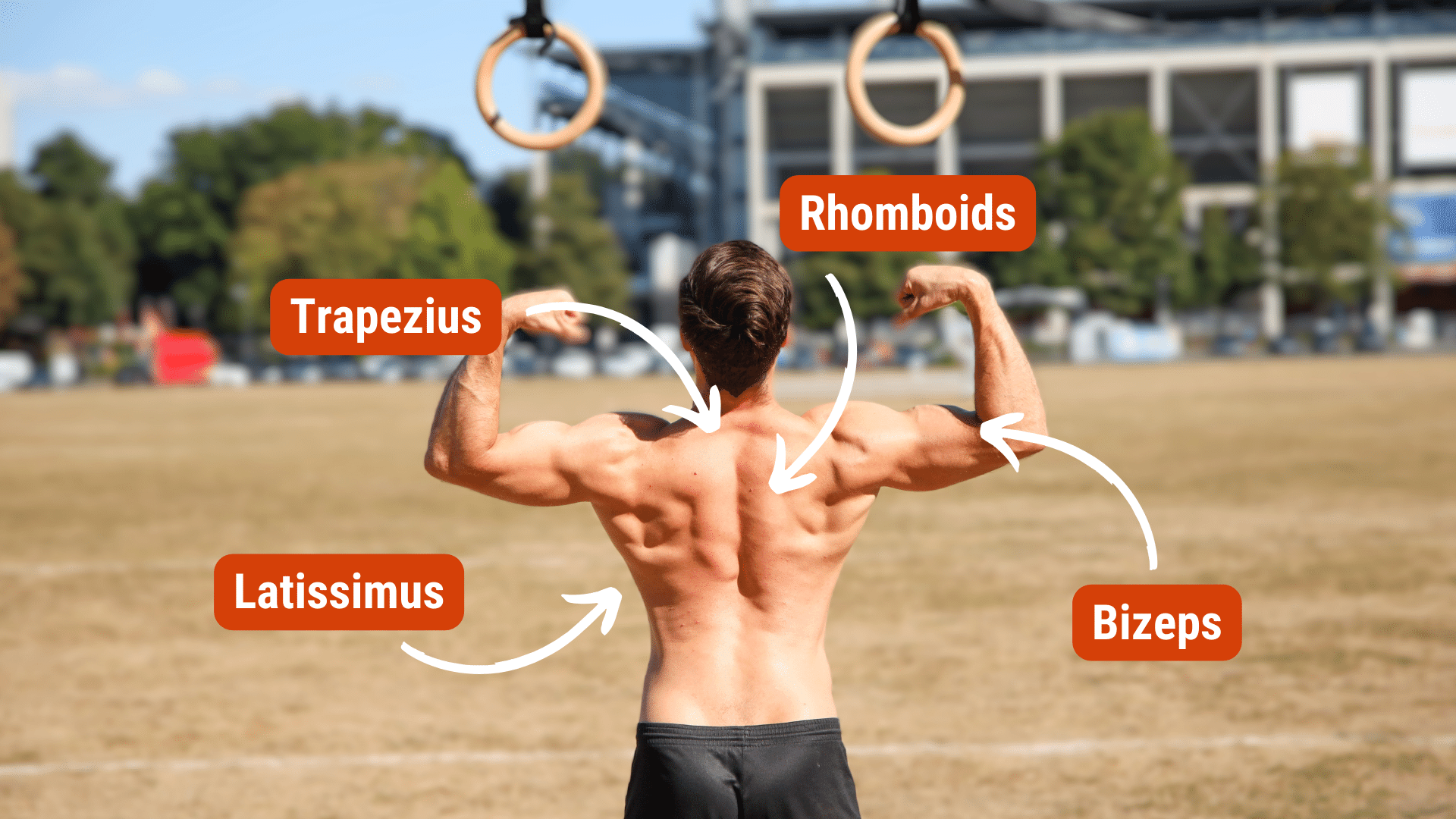
Rowing on the rings covers an essential movement pattern of your body: pulling loads. Its effectiveness as a back exercise stems from the strain on some of your body’s largest muscles. In addition to building muscle, it promotes the release of growth hormones, helps burn calories and stabilizes your spine, which helps protect against injury.
Whether you want to improve your fitness level, increase your muscle strength, or simply pursue a more active and healthier lifestyle, rowing on the rings is an excellent choice.
So, whether you want to improve your fitness level, increase your muscle strength, or simply lead a more active and healthier lifestyle, rowing on the rings is an excellent choice. In the next chapter, we will go into various preliminary exercises that will help you to perform this exercise correctly and effectively. Stay tuned to perfect your entry or technique in wrestling training!
Pre-Exercises for Rowing at the Rings: Find Your Level
Rowing on the rings is a versatile exercise that can be adapted to any level of performance through various pre-exercises. Here are three pre-exercises, ordered by increasing intensity, to help you find the right challenge for your current fitness level:
1. Rudern - Hohe Position
- Beschreibung: Bei dieser Variante befindet sich dein Körper in einer aufrechteren Position, wodurch ein großer Teil deines Körpergewichts durch die Beine getragen wird. Dein Körper bildet einen leichten Winkel zum Boden.
- Besonderheit: Diese Übung ist besonders flexibel, da du die Intensität stufenlos anpassen kannst, indem du deine Körperposition veränderst. Je flacher der Winkel, desto intensiver die Übung.
- Ziel: Diese Anpassbarkeit macht die hohe Position ideal für Einsteiger*innen, da sie es ermöglicht, allmählich mehr Gewicht einzusetzen und die Muskeln bewusst anzuspannen.
2. Rudern mit angewinkelten Beinen
- Beschreibung: Hier startest du in einer waagerechten Position zum Boden mit angewinkelten Beinen. Dein Körper bildet eine waagerechte Linie vom Kopf bis zu den Knien.
- Vorteil: Diese Übung steigert die Intensität, da mehr Körpergewicht in die Übung integriert wird.
- Ziel: Fokussiere dich auf die Stabilisierung deines Rumpfes, während du die Bewegung ausführst.

3. Rudern - Waagerechte Position
- Beschreibung: Die anspruchsvollste Variante, bei der dein gesamter Körper in der Startposition parallel zum Boden in einer waagerechten Position ist.
- Vorteil: Diese Position fordert die gesamte Rumpf- und Oberkörpermuskulatur maximal und bietet die höchste Intensität.
- Ziel: Halte deinen Körper stabil und gerade, während du die Bewegung ausführst, was eine hohe Kraft und Körperkontrolle erfordert.

Choose the pre-exercise that matches your current status and work your way up gradually. Keep in mind that the right technique is crucial in every exercise to avoid injury and get the most out of your workout.
At the end of this blog post, we will also look at the training methodology. There you will learn how often you should train rowing, how many reps and sets are ideal and how to increase your training properly. This information will help you design your training sessions effectively and make steady progress. So stay tuned to take your ring training to the next level!
In the next chapter, we’ll go over the key points of technique that you should consider in all preliminary exercises to avoid injury and get the most out of your training. Stay there and learn how to optimize your performance when rowing the rings!
Tech Tips for Efficient Ring Rowing: How to Do It Right
Rowing on the rings is an excellent exercise to strengthen your upper body and especially your back muscles. For beginners, however, it can be difficult at first to activate the target muscles correctly. This is because train movements are rare in everyday life, as many everyday accessories such as cars and shopping carts relieve us of our work. Therefore, it is important to learn the technique consciously. The following points should help you to perform the exercise effectively and safely. Note that these technique points apply to all preliminary exercises.
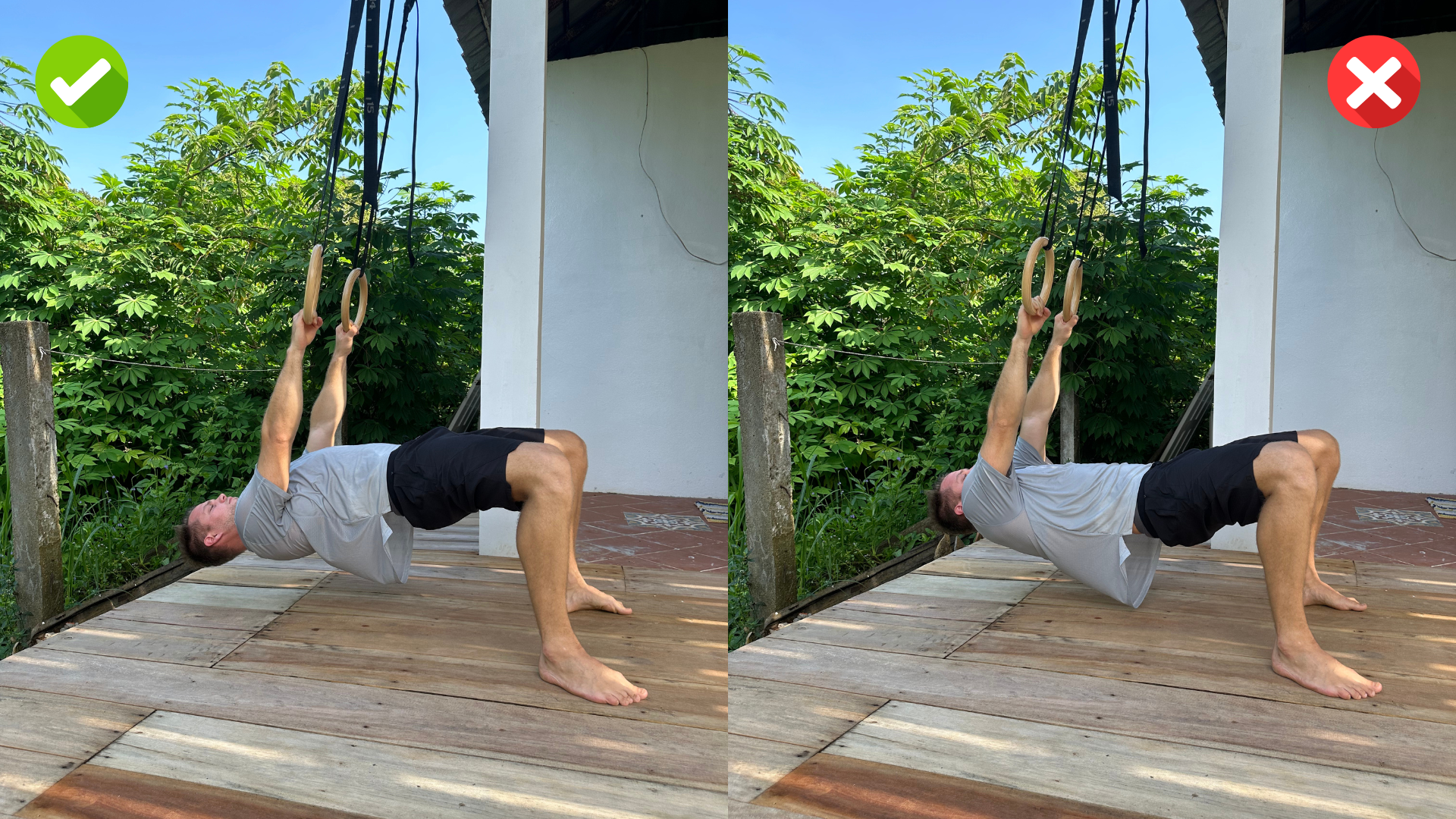
1. Maximum hip extension and buttocks muscles
Pay attention to a maximum stretch of your hip. Here it is important to actively tense the buttocks muscles, which is often forgotten. This ensures a more stable position and more effective power transmission during the exercise. In addition, your stable body provides the necessary resistance that your muscles should overcome when rowing.
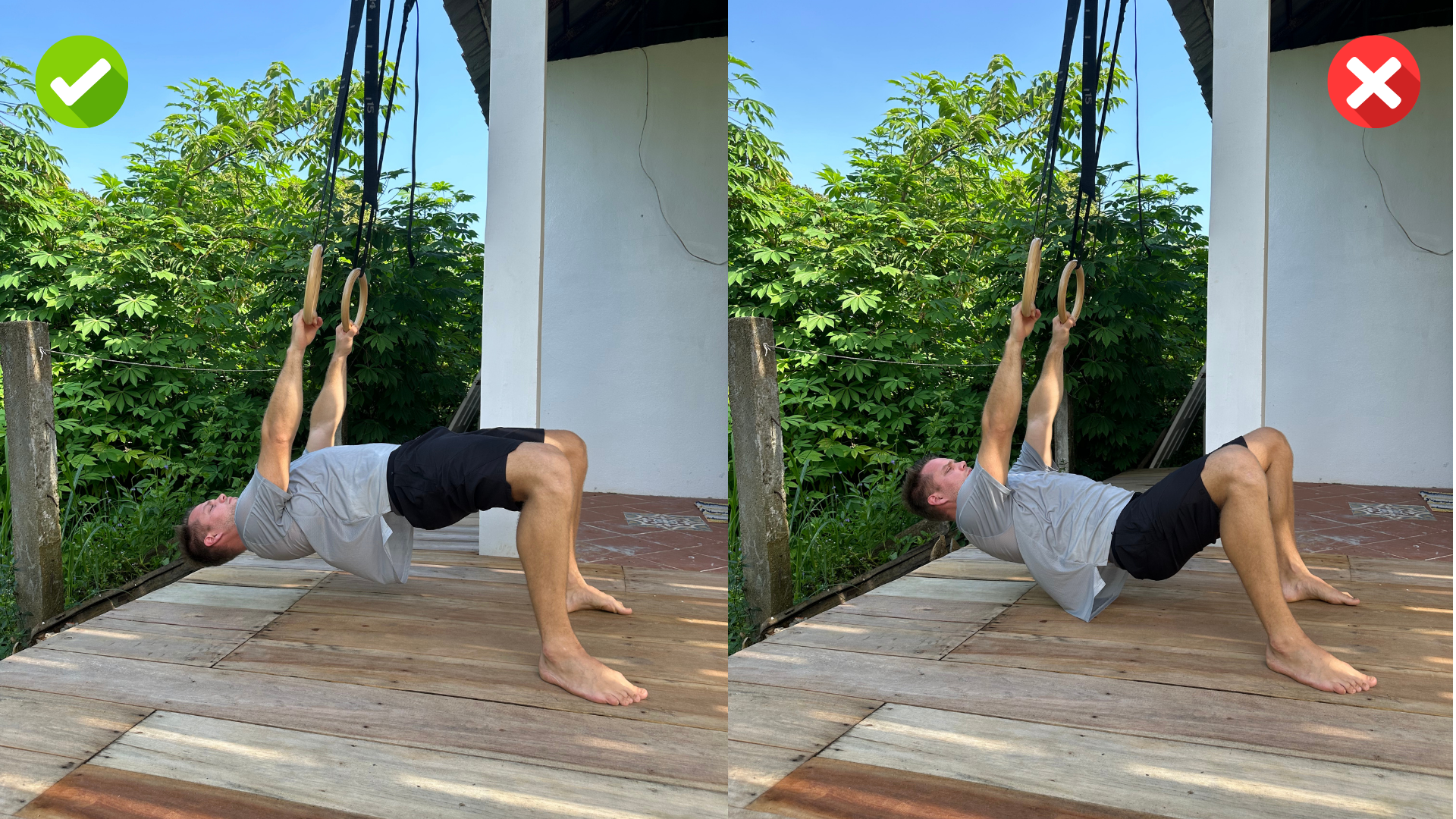
2. Deep shoulder blade position
Your shoulder blades should be controlled and positioned properly. They should be directed downwards and kept away from the ears to properly distribute the load on the back muscles.
Boost your productivity.
Start using our app today.
If you are not really successful yet, try our extra training “shoulder blade control” in the DIE RINGE App. Here you can improve the mobility and control of your shoulder blades and at the same time work on your body posture. So that you can start your training directly, secure a 30-day free access to the DIE RINGE App here. Click on the button on your smartphone and the test period starts automatically after installation. After 30 days, access ends automatically, so you do not even need to cancel. So you have nothing to lose, except maybe your neglected posture. 🙂
3. Range of Motion
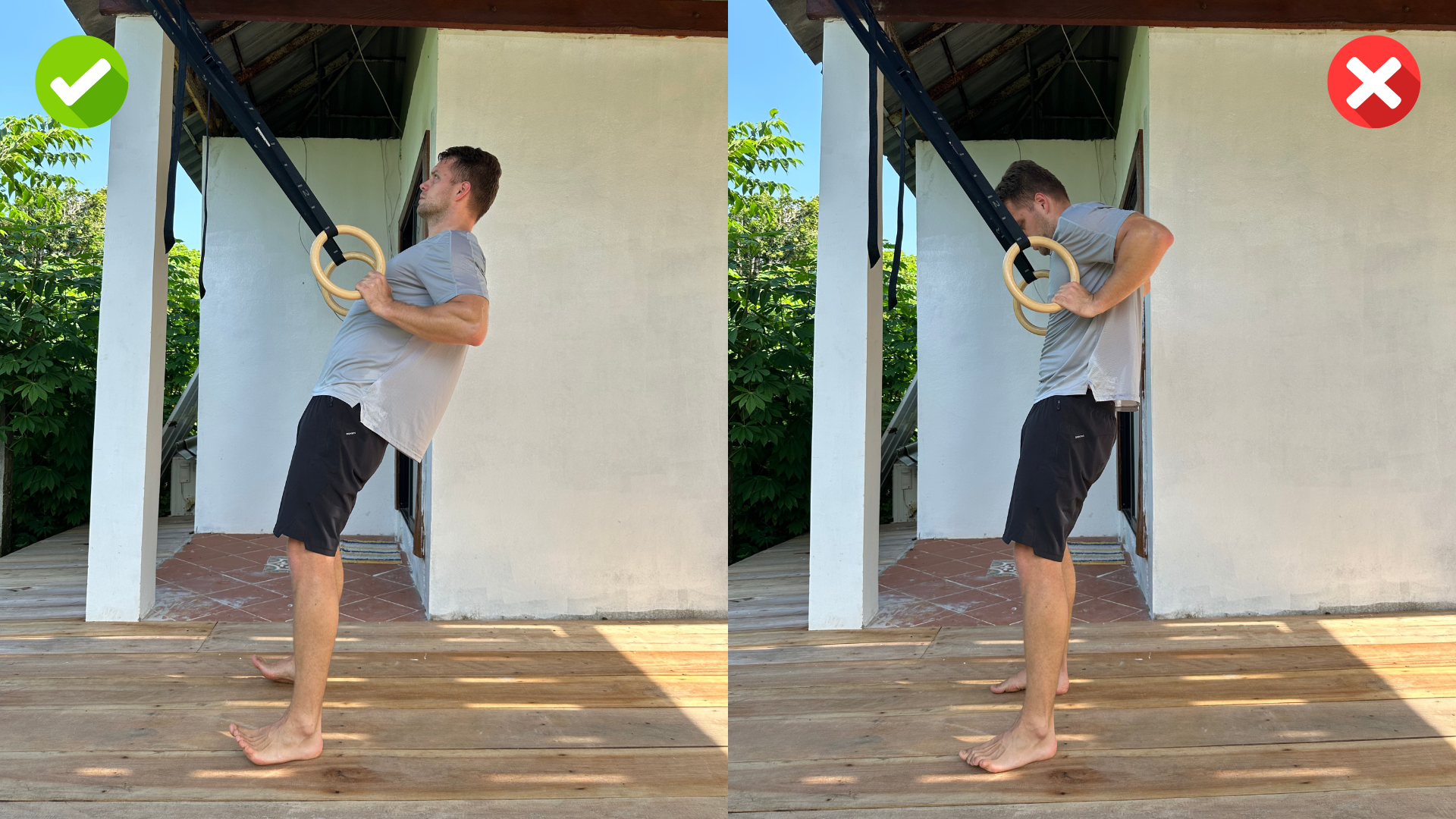
Pull the elbows up to your chest and use the maximum range of motion, but don’t pull the elbows too far past the body. Drawing back too far can cause your shoulder blades to tilt forward. This movement pattern is quite natural and is also needed if you want to scratch your back, for example. In rowing, this is not effective, since the latissimus is no longer effectively trained. A good guideline is that the rings touch your chest. So you use the full range of movement without putting your shoulder blades in an unfavorable position.
4. Posture and shoulder blade dynamics
In the final position of rowing, when the rings are on the chest, you should take a proud posture with the sternum pushed out and shoulders pulled down. In the starting position, with long arms, you can achieve a greater pre-stretch of the latissimus by slightly sliding forward the shoulder blades. Just let gravity drag you down. In this maximally stretched position, the large back muscle (latissimus) must apply force and is thus trained over a longer movement path. Make sure that the shoulder blades do not slide upwards (elevation), but stay deep (depression).
By observing these technical points, you make sure you get the most out of your ring training. In the next chapter we explain the training methodology and give you tips on the optimal training frequency, repetition and set number as well as on how to increase your training effectively.
Training plan for ring rowers: methods for optimal results
Rowing on the rings is an effective exercise for muscle building and strength development. To get the best results, it is important to follow the correct training methodology. In this chapter, we answer the most important questions so that you can optimally start rowing.
1. Training frequency
Ideal are 2-3 training sessions per week. This allows for a balanced balance between stress and recovery.
2. Number of rates per unit
Start with 3-4 sets per training session. This provides a solid basis for building strength without overloading the body.
3. Combination of different preliminary exercises
You can either do all the sentences of a specific preliminary exercise or mix the sentences. For example, you can do the first two sets of bent leg rowing to work hard, and then switch to high-position rowing in the two subsequent sets to create more repetitions to muscle fatigue. This approach allows you to work on both your strength and your strength endurance.
4. Repeat range
The goal is to train in a rep range of 3-20 reps. This allows a versatile development of strength and muscle mass. For example, when rowing at an angle in the first two sets, you could use 5 or 5. 3 repetitions. In the so-called "Back Off" sets, when rowing in a high position, you could then manage about 15 repetitions. Through this approach, you effectively train both strength and muscle building and provide growth stimuli that are essential for proper rowing.
5. Progress and transition to more difficult exercises
If you’re able to complete 10-15 clean reps on one exercise, that’s a good sign that you’re ready to try the next, more difficult exercise. Perhaps start with a set of the more challenging exercise. It is important to understand that in the field of calisthenics, there are no strict guidelines as to when exactly is the right time to switch to the next exercise. Especially since the intensity of rowing in high position is infinitely adjustable and varies individually, it is not possible to determine exactly when you are ready for the next level. Calisthenics is often about trying things out and determining if you have built up the necessary skills and strength through previous training sessions to tackle the next level of progression.
6. Progressive load increase with focus on repetitive increase
An essential aspect of training progress is the progressive increase in load. The goal should be to boost yourself with each workout, ideally by trying to create at least one more repetition per workout. This continuous increase in the number of reps not only improves your muscle strength, but also ensures constant training incentives that are crucial for muscle growth. In addition to increasing repetitions, you can also increase the number of sets or optimize your technique to ensure comprehensive development. Each of these methods forces your muscles to adapt to the increased demands, which allows you to make effective progress in your training.
7. Holistic training
To avoid dysbalances, in addition to rowing, you should also integrate pressure exercises such as pushups into your training. Take a look at our Push-ups of blog articles to learn more about effective pressure exercises.
Optimize your wrestling row training with the DIE RINGE App
You want to start rowing on the rings, but planning and tracking your workout seems complicated? Don’t worry, there is a simpler solution: the “DIE RINGE” app. With this app, you no longer have to worry about the intricacies of the training methodology, because it was specifically designed to do all of this for you. The app plans your training week based on your current level of performance and training opportunities, taking into account sports science standards. It increases you from training to training and recognizes when you are ready for the next exercise. This allows you to focus fully on your training without worrying about planning. You can easily track your training sessions in the app, which is much more practical than conventional methods with pen and paper. Use the "DIE RINGE" app to make your ring training efficient and targeted and to achieve fast progress. Try it out and see how easy and effective your training can be.
Conclusion: Maximize Your Fitness with Ring Rows
Ring rows are an excellent exercise to strengthen and shape your body holistically. In this article, we’ve highlighted the numerous benefits of this exercise, from improving overall strength and endurance to activating and strengthening important muscle groups like the back, arms, and abdomen. We have presented various pre-exercises that allow you to start regardless of your fitness level and gradually move on to more challenging variants.
The technique of rowing on the rings is crucial to the success and safety of your training. We discussed the main points of technique, including maximum hip extension, shoulder blade control, correct range of motion, and a proud posture in the final position.
In addition, we have provided a comprehensive training methodology guide, including recommendations on training frequency, sets, repetitions and progressive load increase. This will help you design your exercise routine effectively and make continuous progress.
Finally, we introduced the "DIE RINGE" app, which is a valuable resource for your training. With this app, you can plan, track and optimize your training according to scientific standards to get the most out of your wrestling training.
We hope this article helped you develop a deeper understanding of rowing on the wrestling and inspired you to incorporate this powerful exercise into your training program. Remember to train consistently, constantly improve your technique, and most importantly, enjoy the process and the positive changes it brings. Good luck!