The Perfect Pull-Up – Avoid These 5 Mistakes for Maximum Success!
Common Mistakes in Pull-Up Training and How to Avoid Them
Error 1: Incomplete range of motion
The importance of full range of motion
Pull-ups are one of the exercises where you can easily cheat yourself. Often the entire range of movements is not exploited, which reduces the benefit of the exercise – only to create 2-3 more repetitions. In order to train all participating muscles optimally, you should start the pull-up in the complete slope and pull yourself up to the maximum. The subsequent controlled lowering into the slope, the so-called eccentric phase of movement, stretches your muscles under tension. The resulting mechanical overload stimulates your body to repair and thicken the muscle fibers.
Use the full range of motion for maximum muscle growth
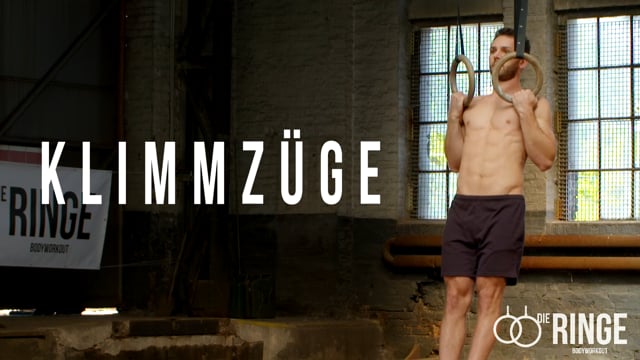
By taking full advantage of the eccentric phase, you promote your muscle growth. Pull-ups on gym rings, such as the rings from DIE RINGE, are especially effective because your wrists can rotate freely and your back and arm muscles can be better lengthened. This keeps your muscles under tension for longer and maximizes muscle growth.
Mistake 2: Too high speed
The speed at which you perform pull-ups is crucial for training success. Whether on the bar or on the rings, pull-ups are often carried out too quickly, which reduces the benefit of the exercise.
Eccentric phase: Reduce pace for better results
In the important eccentric phase, you should make sure to reduce the speed. This stretches your muscles under load and can work effectively against gravity. Thus, the muscles remain under full tension, which is essential for the desired muscle stimuli.
By keeping the right speed on pull-ups, especially in downward motion, you ensure effective training and maximum results. Give your muscles the opportunity to develop optimally by adjusting the pace and consciously paying attention to the eccentric phase.
Mistake 3: Too much arm muscle work due to unstable shoulders
Stable shoulders for effective pull-ups
In order to get the most out of your pull-ups, it is important to stabilize your shoulders and thus use your back muscles efficiently.
Activation of back muscles instead of excessive bicep work
The arm flexor plays an important role in pull-ups, but compared to the back muscles, it is a small muscle. To get your back in optimally, focus on the kick-off movement: Stabilize your shoulder belt by pulling your shoulder blades back and down. This creates the necessary basis for efficient work of the large back muscles and better power transmission. Practice this introduction of the pull-up as well as the rest of the movement sequence.
Error 4: No alignment of the spine
Importance of an aligned spine in pull-ups
An aligned spine is essential for a correct pull-up execution and enables an effective interaction of the muscles involved.
Straight back for maximum performance and injury prevention
During pull-ups, often observe how the athlete's back stretches and the thoracic spine is curved to bring the chin over the rod. However, a straight back is just as important as squats or deadlifts to avoid injury and exploit the full movement potential.
To prevent overextension and subsequent bending, tense your buttocks and torso before each pull-up. This will put your pelvis in a neutral position and straighten out the lumbar spine. Maintain tension throughout the pull-up by stretching your legs and not pulling them back crossed.

Mistake 5: Pull-ups with swing
Pull-ups without swing for effective muscle building
Pull-ups with swing, as they are used in Crossfit or similar competitions, have their justification. However, they are not optimal for strength and muscle building.
Avoid momentum for maximum muscle work
Momentum takes work away from you and shortens the time of pull-up performance, making your training less effective. To exploit the full potential of your muscles, avoid momentum, especially in downward motion. Hold a brief moment in the starting position to prevent momentum.
Your way to the first clean pull-up
Want to learn more about pull-ups or master your first clean pull-up? Our training program is just right for you!
Progressive training for effective pull-up learning
With progressively increasing exercises, you learn to perform the pull-up cleanly and expand your repertoire of pull-up variants. Our training plan also trains your entire upper and lower body in a balanced manner, so that you build up sustainable muscles and get fitter.
Now try the DIE RINGE App for free
Learn your first pull-up or perfect your technique with the DIE RINGE App!